Which one do I need?
Rules move the work. Judgment decides where it goes. Why enterprise RPA and an AI teammate are two halves of the same team.

Lucas Ochoa
11.2.2026
Share:

At first glance, a production workflow and an AI teammate look like two products that wandered into the same company. One runs loan files through a regulated pipeline thousands of times a day. The other answers your texts, chases a vendor, and books your flight.
Since we launched Ace a few weeks ago, the question I get most is some version of: which one do I need? Do I need both? How do these two even relate?
My answer always starts in the same place: how work actually gets done. There are two ways to automate it. You can find a specific workflow, map it, and automate it end to end. Or you can give your team a general-purpose agent that does the work around those workflows, and along the way shows you which ones are worth automating next. Watch any team for a week, and you'll want both.
Two types of work
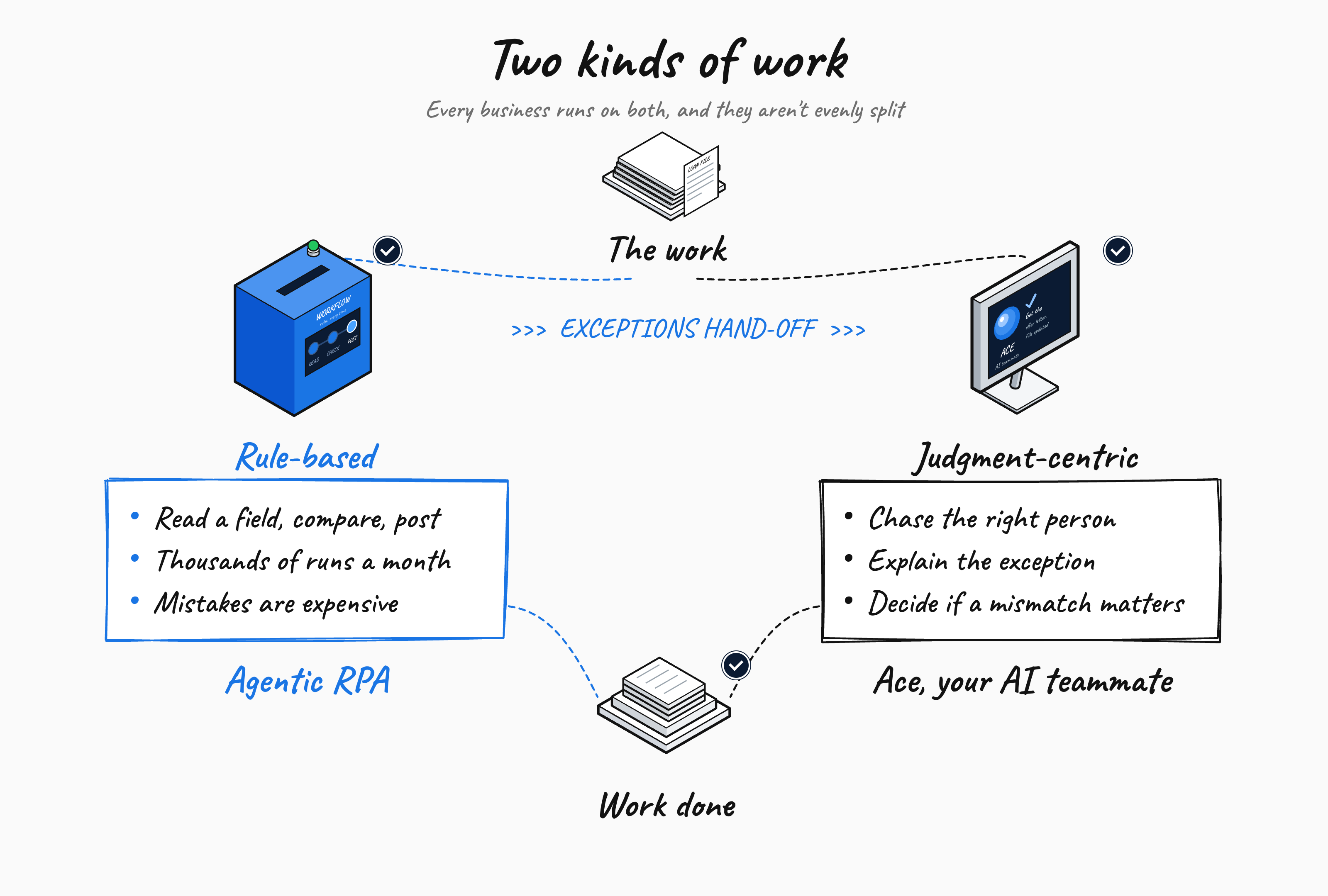
Every business runs on two kinds of work, and they aren't evenly split.
The first kind follows rules. Read this field, compare it to that one, post the result. It repeats thousands of times a month, and when it goes wrong, it goes wrong expensively. The way to handle it is to identify the workflow, write it down step by step, and automate it end to end. That was the idea behind RPA back in 2012, and the idea was right. The scripts were just brittle.
The second kind needs judgment. Chase the right person. Explain the exception. Decide whether a mismatch actually matters. Write the email that gets a borrower to send one more document without feeling accused of something. This work doesn't repeat cleanly, so you can't map it ahead of time, and nobody automated it. We hired for it instead. This is where Ace, our AI teammate, comes in. Ace is a general-purpose agent, so it doesn't need the workflow defined up front.
The two work best side by side. Picture a modern car factory. You can put humanoid robots on the line for the varied jobs that need a person’s flexibility, but you’d never ask one to be the conveyor belt or to lift an engine block. That’s what purpose-built machines are for. Ace and Automat Studio split the work the same way. Studio builds the deterministic, reliable workflows that run the same way every time. Ace is the general-purpose teammate around them, and when a task deserves its own machine, Ace hands it to Studio.
The judgment calls are the business
Rules can tell you a pay stub doesn't match the application. They can't tell you whether it matters, who needs to know, or how to ask the borrower so they actually reply. Those small calls are how a company really runs. The rules move the work. The judgment decides where it goes.
You can't map that kind of work in advance, which is why automation programs always grew an exceptions team right next to them. A general-purpose agent flips that. It handles the calls as they come, and it notices when the same call keeps coming back. That's your next workflow.
Two things changed in the last eighteen months. First, automating a specific workflow stopped being brittle. When a screen changes, an agentic workflow reads the new screen instead of falling over. Second, general-purpose agents got good enough to take on a real share of the judgment work. An AI teammate can hold context across email, a spreadsheet, a portal and a phone call. It can send the follow-up and read the reply, decide what's worth escalating, and ask a person when it isn't sure.
A workflow and an agent on one loan file
Here's what that looks like on a single loan file.
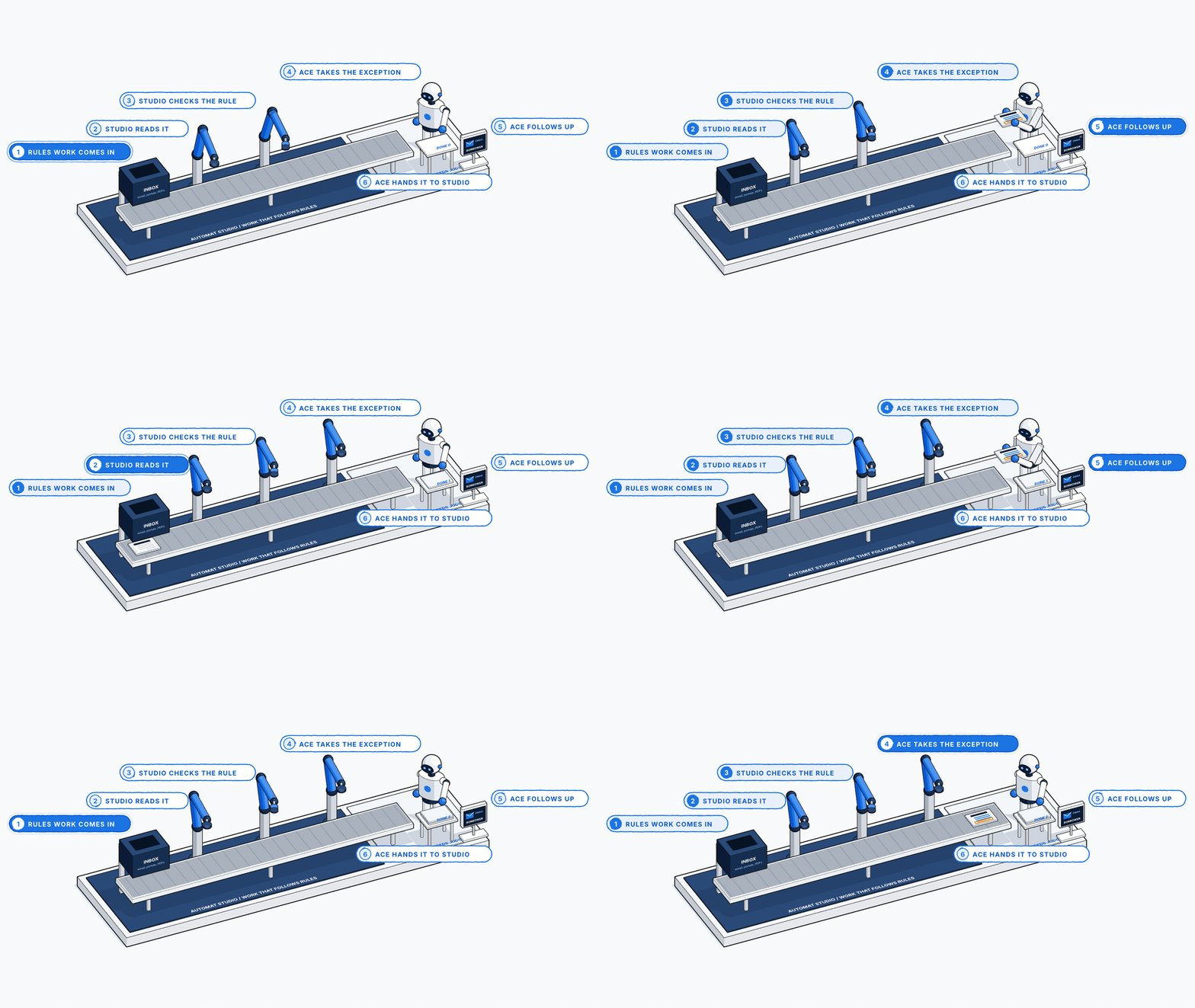
A file comes in at 4:52 on a Friday. A workflow picks it up, pulls the borrower's documents, reads the income off a pay stub and checks it against the application. It does this four hundred times a day and almost never gets it wrong. It's fast, it's auditable, and it does the same thing every time, which is exactly what you want when a regulator asks how a number was produced.
Then the pay stub is from a new employer, and the start date doesn't line up. In the old version of this story, the file sits in an exceptions queue until Monday. Someone emails the loan officer, chases the borrower for an offer letter and forwards it to underwriting with a note. Three people, four emails and most of a day, for a file the bot had finished in eleven seconds.
Now the exception lands with Ace. Ace already knows the borrower, the loan officer and the deadline. It emails the borrower for the offer letter, reads it when it shows up, attaches it to the file and tells underwriting what changed and why. If anything looks off, it asks a person before it acts. By Monday morning, the file has already moved.
Same job, two workers. One handles the rules, one handles the judgment, and they hand off to each other the way two people on the same team would. Follow the handoffs, and you can see where the cost was hiding. It was never in the eleven seconds. It was in the three days between the bot stopping and a person picking it up.
Not just mortgage
We started in mortgage because the volume is enormous and mistakes are expensive. The same split shows up everywhere.
A brokerage has listings that move through the same steps every time, and agents who need a hundred small things done around them. A ten-person company has one person doing both kinds of work and running out of hours.
Some work should be a workflow, some should be a teammate, and the expensive part is the gap between them. That's why Automat builds both. Core automates the workflows you've identified, built for regulated environments and to show its work. Ace is the general-purpose teammate for everything around them, and it helps you spot the next workflow worth handing to Core. The two talk to each other, so the work doesn't stop when the rules run out.
So, which one do you need? Here's where I'd draw the line. If you can write the task down step by step and someone might audit it, make it a workflow. If it needs context, tact or a decision, or you're not sure yet what the workflow even is, start with a teammate. Most jobs are a mix of both, which is why most businesses end up wanting the two working together.
Gautam and I started Automat three years ago with one belief: that every company deserves the automation muscle only the biggest ones could afford - to reduce work, not relocate it. Fast forward to now, with Ace and our managed automations working hand in hand on the same team, the picture is clearer than ever.
From the blog








One Of The Largest Public RPA Companies Tried to Invest in Us
This is the second edition in a series on where enterprise automation is headed. The first made the case for why manual work persists. This one gets specific: the root cause, the places it surfaces, and what fixing it takes.
Lucas Ochoa
8.7.2026